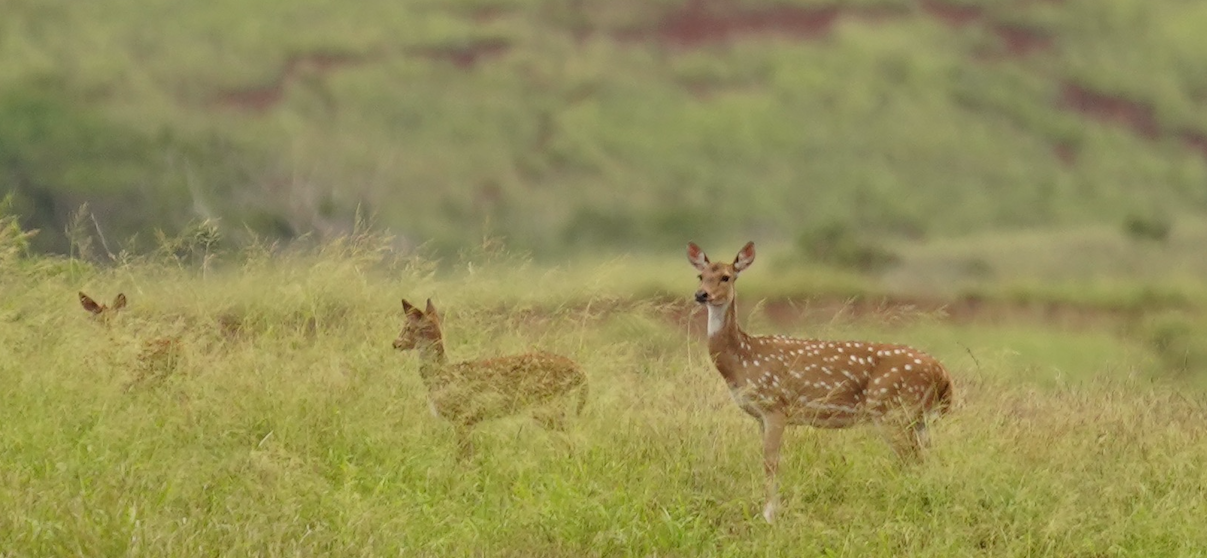
An axis deer mother and fawns, surrounded by abundant wet season grasses. By September, deer will graze most of this to within a few inches of the ground, reducing fire fuel while recycling nutrients back into the ecosystem.
Click here for the audio version.
When the Lahaina fire tore through West Maui in August 2023, it killed over 100 people, destroyed nearly 2,000 homes, and inflicted billions in damage. In the aftermath, the questions came fast: Why weren’t more fire control measures in place on the grasslands surrounding Lahaina? What could have been done there and elsewhere?
One answer has apparently been ignored: axis deer.
Across Maui Nui (Maui, Molokaʻi, and Lānaʻi), tens of thousands of axis deer roam a landscape with no natural predators. They are often described as a plague. The ASU Swette Center’s 2024 capstone report, commissioned by the Maui County Department of Agriculture, highlights their transgressions: crop devastation, watershed degradation, native plant destruction, erosion, food insecurity. The Hawaiʻi Department of Land and Natural Resources calls them one of the state’s most destructive invasive mammals.
The governor’s office recently issued the 27th Emergency Proclamation related to axis deer. Emergency declarations allow DLNR and DOFAW to renew contracts indefinitely without competitive rebidding or data transparency. Because proclamations suspend Chapters 103D (Procurement Code) and 343 (Environmental Impact Statements), there’s no statutory requirement for DOFAW to publicly post expenditure reports until after the emergency ends. In other words, millions have been spent with no reported success.
While axis deer are turning into the longest-running “emergency” in Hawaii history, not one official document frames these animals as a fire management asset. But, why should they?
The California Warning
Eighteen hundred miles east of Maui Nui, an island wildfire disaster is unfolding. In May 2026, a wildfire ignited on Santa Rosa Island—part of California’s Channel Islands—and burned over 16,900 acres, the largest fire in the island’s recorded history. The blaze, sparked accidentally by a shipwrecked sailor’s distress flares, tore through unmanaged brush with devastating speed.
Santa Rosa had a large mule deer population for decades. Imported from the mainland, they were completely eradicated by the end of 2011 as part of an ecosystem restoration plan—the same logic now being applied to nearby Catalina Island. The Catalina Island Conservancy recently secured state approval to use professional hunters with rifles, helicopter spotters, and tracking dogs to exterminate every last one of the island’s mule deer within five years.
Los Angeles County Supervisor Janice Hahn, whose district includes Catalina, connected the dots immediately. “The conditions that are allowing it to rage were deliberate,” she said of the Santa Rosa fire. “The deer population that used to graze brush on Santa Rosa Island was wiped out in 2011. Now we are seeing how quickly fire can move through heavy, unmanaged brush.”
L.A. County Fire Chief Anthony Marrone went further in a formal letter, arguing that maintaining a reduced deer population on Catalina would provide “a measurable reduction in understory vegetation and seedling establishment, moderating fuel continuity.” Total elimination, he warned, would “elevate wildfire risk.”
What the Science Says
The global research on ungulates (deer, goats, sheep, cattle, etc) as fire prevention tools is robust and consistent. A 2021 study involving Big Island goats, sheep and cattle had this wise conclusion: “Ungulates mediate trade-offs between wildfire risk, biodiversity and ecosystem services such as carbon storage and watershed conservation, as well as human recreation and economic activities. Land managers seeking to balance conservation and restoration objectives with wildfire risk should be cognizant of the impacts of non-native ungulate removal on fuels and wildfire behaviour. Dry and mesic moisture zones where wildfire occurrence is more frequent are of particular concern.”
In other words, eradication of non-native ungulates for the sake of native habitat restoration can lead to the destruction of said habitat by wildfires. Just like Santa Rosa Island found out.
The Axis Deer Blind Spot
Maui Nui harbors tens of thousands of mixed-feeding ungulates (deer, sheep, goats and blackbuck antelope) that browse shrubs and graze grasses—precisely the dietary profile the research identifies as optimal for fuel reduction.
Yet the entire policy apparatus treats them almost exclusively as a problem to be eliminated. The ASU capstone report covers environment, agriculture, food security, public health, and culture. Fire management appears nowhere in its scope. The Civil Beat’s April 2026 piece on the coming “Godzilla El Niño” season—which could turbocharge vegetation growth during wet months before drying it all into a tinderbox—never once mentions axis deer as a potential fuel management tool, even as it quotes fire ecologist Clay Trauernicht warning about the “one-two punch” of wet winters followed by dry summers. The ArcGIS storymap documenting axis deer impacts across the islands similarly omits any discussion of fire. The discourse seems frozen: deer equal destruction, not fire prevention or a food source.
That needs to change.
The Civil Beat article quotes Hawaiʻi Wildfire Management Organization Co-Director Elizabeth Pickett making the essential point: “We need to be in a place where land ownership requires land management. The system protects the right for people to do nothing, which has to change.” And the cheapest, most scalable land management tool available across hundreds of thousands of acres is already on the landscape, eating.
A Smarter Framework
No one is arguing for unlimited deer populations. The ASU report documents real agricultural damage. Cattle ranchers have had to destock herds by 50-60% due to forage competition. The watershed impacts from overbrowsing are genuine. Sedimentation from erosion caused by deer overgrazing is harming coral reefs and near-shore fisheries.
But “manage” should never mean “eradicate”. The DLNR’s own target is a tolerance level of roughly 16,000 deer on Maui island. A population that size would still provide meaningful fuel reduction, food supply, and recreational harvest. Strategic management could concentrate deer grazing in firebreak corridors, along the wildland-urban interface, and in the abandoned agricultural lands where invasive grasses have created continuous fuel beds—the very “non-native savannah grasses” that the Civil Beat piece identifies as the primary fire threat. Research shows that water stations and salt licks could steer browsing pressure toward high-risk zones—an approach validated by the Mallorca feral goat study from Spain.
The economic case writes itself. The state and county are spending millions on deer control while simultaneously facing the impossible cost of mechanical fuel treatment across Maui Nui’s steep, remote terrain. Targeted grazing by domesticated goats and sheep in the western US runs significantly cheaper per acre than mowing or herbicide application. Deer already on the landscape perform this service for free. And as the ASU report notes, axis deer serve as a “readily available ‘free’ resource that can be quickly put to use in times of disaster”—Maui Nui Venison donated thousands of pounds of venison for fire victims in the days immediately after Lahaina burned. A managed herd is both fire prevention and food security.
Supervisor Hahn, watching Santa Rosa burn while Catalina’s deer face extermination, put it plainly: “I don’t think anyone has brought forth any evidence that you can manage this kind of brush—native or invasive—without some natural fire management like deer.” She’s right. The science on ungulates’ role in fire management exists in abundance. It has existed for decades. Maui County simply hasn’t considered it.
After Lahaina, after Santa Rosa, the cost of getting this wrong is measured in lives, livelihoods, and native habitat restoration. The choice facing Maui Nui is whether to treat deer and other ungulates as a permanent liability or to recognize them as the only scalable, self-sustaining fuel management tool available across hundreds of thousands of acres. In 1868, Hawaii’s King Kamehameha V received 8 axis deer as a gift. Fire management and food are two great ways to steward the gift.

